
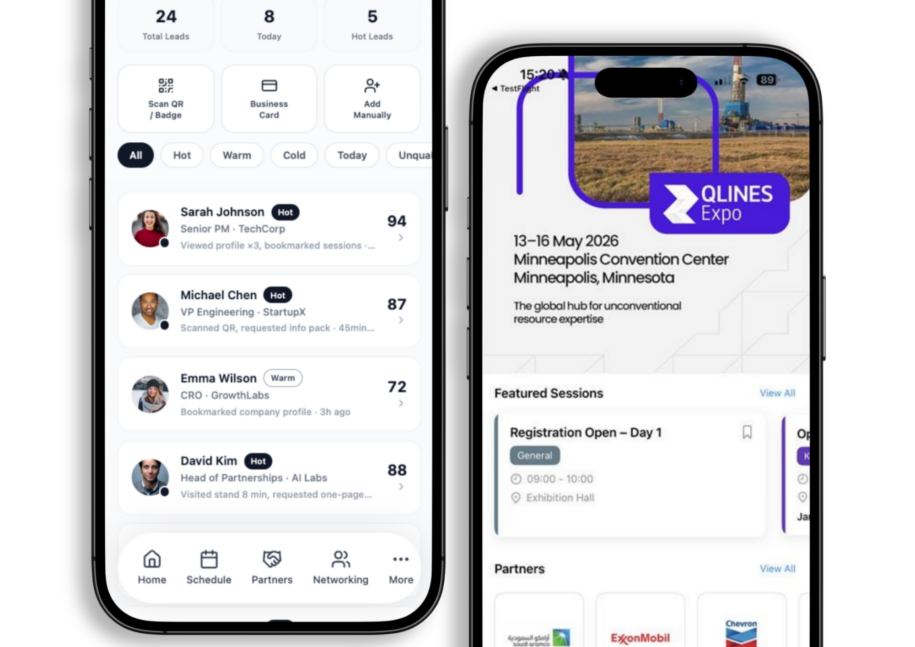
7 Lead Retrieval Tips
for Trade Show Exhibitors
Discover how to capture richer context, qualify high-intent buyers, and turn badge scans into real revenue.
Find out moreMastering effective lead retrieval strategies is essential for any modern trade show exhibitor looking to maximize event ROI. Without the right workflow, valuable booth interactions can easily slip through the cracks.
For additional industry best practices on scaling your conference presence, you can check out insights from Exhibitor Online or explore comprehensive strategies via TSNN.
Why Lead Retrieval Matters for Your Booth Strategy
When thousands of attendees walk the exhibition floor, utilizing streamlined lead retrieval tools ensures that your sales reps spend less time manual-typing contact cards and more time engaging high-intent prospects.
Optimizing Your Lead Retrieval Process
Advanced lead retrieval software allows teams to instantly sync attendee data, assign custom follow-up tags, and trigger automated emails before the conference floor even closes for the day.
A busy trade show booth can generate hundreds of conversations. But a long list of scanned badges does not necessarily mean a long list of good leads.
The best event lead retrieval software should help exhibitors do more than collect contact details. It should make it easy to capture who someone is, understand why they are interested, record useful context and give sales teams everything they need to follow up quickly after the event.
For event organizers, choosing the right lead retrieval technology also matters. Better tools can improve the value exhibitors receive from the event and give organizers clearer evidence of exhibitor engagement and ROI.
AITL Exhibitor Insight
What we see exhibitors get wrong most often: Treating the badge scan as a passive tally counter rather than an active conversation prompt. Exhibitors often rush to collect high volume without qualifying intent, resulting in sales teams returning from events with a spreadsheet of cold names instead of actionable buyers.
Here are seven things exhibitors and event organizers should consider when looking for the right software.
What should you look for in event lead retrieval software?
At a minimum, good lead retrieval software should provide:
- Fast badge scanning
- Reliable offline lead capture
- Notes and custom qualification questions
- Lead ratings or intent signals
- Team access and lead management
- CRM integrations or simple exports
- Tools that make post-event follow-up easier
Here are seven things exhibitors and event organizers should consider.
1. Make badge scanning genuinely quick
At a busy exhibition stand, nobody wants to interrupt a good conversation to complete a long form.
Badge scanning should take seconds.
A scan should immediately capture the attendee information the exhibitor is permitted to receive, allowing the conversation to continue naturally.
When evaluating a badge scanning app, check:
- How quickly a badge can be scanned
- Whether scanning happens directly inside the event app
- What attendee information is captured
- Whether exhibitors need additional hardware
- Whether scanning works if the venue internet connection is poor
Offline capability is particularly important. Exhibition halls are notoriously difficult environments for Wi-Fi and mobile data, so exhibitors should still be able to capture leads when connectivity drops and sync them later.
The best badge scanning experience should feel almost invisible to the attendee.
2. Capture context, not just contact details
A name, company and email address tell the sales team who they met.
They don't tell them why the person was interested.
This is one of the biggest differences between basic badge scanning and useful exhibitor lead capture.
Exhibitors should be able to add information such as:
- Notes from the conversation
- Products or services the attendee is interested in
- Buying timeframe
- Follow-up requirements
- Lead rating
- Custom qualification questions
- Next steps
Imagine returning from a trade show with 300 leads.
One spreadsheet contains names and email addresses.
Another tells you that 22 people asked for a demo, eight have an active project this quarter and four specifically requested pricing.
The second list is far more valuable.
Good lead retrieval captures the conversation as well as the contact.
3. Look beyond the badge scan for signs of buyer intent
A badge scan is an important signal, but it is not the only way an attendee can demonstrate interest in an exhibitor.
Modern event apps can generate valuable engagement signals before, during and after the event.
For example, an attendee might:
- View an exhibitor's profile
- Bookmark a company or product
- Request a meeting
- Exchange contact details
- Attend a sponsored session
- Download content
- Scan an exhibitor's QR code
- Message an exhibitor through the event app
These actions can provide valuable context around a lead.
Someone who viewed an exhibitor several times, bookmarked their profile and requested a meeting may deserve very different follow-up from someone whose badge was scanned while collecting a giveaway.
This is where event lead retrieval software is moving beyond simple scanning towards lead intelligence.
Instead of asking only: Who did we scan? Exhibitors can begin asking: Who appears genuinely interested in what we offer?
That makes it much easier to prioritise the right opportunities after the event.
4. Make lead qualification simple enough that teams actually use it
Lead qualification features are only useful if exhibitors use them.
If every badge scan requires completing ten questions, booth teams will either stop using the system or rush through the answers.
The best approach is usually a small number of meaningful qualifiers. For example:
- Interest:
- Product A, Product B, Partnership, General information
- Priority:
- Hot, Warm, Long-term opportunity
- Next step:
- Send information, Book a demo, Provide pricing, Call next week
Organizers should ideally give exhibitors the flexibility to create qualification questions that make sense for their own sales process.
This turns conference lead generation from a numbers exercise into a structured sales workflow.
5. Check what happens to the lead after the event
One of the most important questions to ask a lead retrieval provider is: What happens after we scan the lead?
Some platforms make it easy to collect hundreds of leads but leave exhibitors with a CSV file and a large follow-up job on Monday morning.
Look for software that supports:
- Real-time lead access
- CSV or Excel exports
- CRM integrations
- Lead assignment
- Notes and qualification data in the export
- Automated or AI-assisted follow-up
- Follow-up reminders or suggested next actions
The faster a useful lead reaches the right salesperson, the easier it is to continue the conversation while the event is still fresh.
This is particularly important at large trade shows where sales teams may collect hundreds or even thousands of contacts.
Lead retrieval should not end when the badge is scanned. It should create the starting point for follow-up.
6. Make sure the whole booth team can work together
Lead capture becomes much harder when several members of a team are working on the same exhibition stand.
Good trade show technology should allow multiple team members to scan and qualify leads while keeping everything together under the exhibitor account.
Exhibitors should be able to answer questions such as:
- Who captured this lead?
- What was discussed?
- Has someone already followed up?
- Which team member should own the opportunity?
- Which leads should be prioritised?
This becomes especially useful for larger exhibitors with salespeople covering different products, regions or customer types.
Without shared visibility, valuable leads can easily be contacted twice — or not at all.
7. Measure lead quality, not just the number of scans
It is tempting to judge trade show performance by one number: We collected 500 leads.
But 500 badge scans do not necessarily represent 500 sales opportunities.
A more useful lead retrieval strategy looks at the quality and context behind those interactions. Exhibitors might consider:
- Number of qualified leads
- High-intent prospects
- Meetings generated
- Leads requesting follow-up
- Engagement with the exhibitor profile
- Products generating the most interest
- Lead activity by booth team member
- Leads moved into the CRM
- Opportunities or revenue created after the event
For organizers, these insights can also help demonstrate the value exhibitors are receiving from the event.
If an exhibitor can clearly see that the event generated meetings, high-intent prospects and qualified opportunities — rather than simply footfall — it becomes much easier to understand their return on investment.
Frequently Asked Questions
What is the difference between badge scanning and lead retrieval?
Badge scanning captures attendee information. Lead retrieval turns that information into a usable sales lead.
A basic badge scanner may record a person's name, company and contact information. More advanced event lead retrieval software can add qualification questions, notes, lead ratings, engagement signals, team collaboration, CRM integrations and follow-up tools.
That distinction matters because the objective of exhibiting is rarely to collect the largest possible database. It is to identify the people most likely to become customers, partners or valuable business relationships.
How should exhibitors choose event lead retrieval software?
Before choosing a platform, ask the provider these questions:
- Can exhibitors scan badges directly from a phone?
- Does scanning work offline?
- What attendee data becomes available after a scan?
- Can exhibitors add notes and qualification questions?
- Can the system identify other engagement or buyer-intent signals?
- Can multiple booth team members use it?
- Can leads be exported immediately?
- Does it integrate with our CRM?
- What tools help exhibitors follow up after the event?
- What reporting is available to exhibitors and organizers?
If the answer is simply “you can scan badges and download a spreadsheet afterwards,” it may be worth looking more closely at what other platforms can offer.
The best lead retrieval software connects the scan to the sale
The role of lead retrieval is changing.
Badge scanning is still important, but it should be the beginning of the process rather than the end.
The strongest event lead retrieval software helps exhibitors: Spot opportunity → capture context → prioritise leads → follow up with confidence.
That means combining straightforward badge scanning with lead qualification, attendee engagement signals, team collaboration, integrations and better post-event follow-up.
For organizers, providing those tools can also make the event more valuable to exhibitors — because exhibitors can see not only how many people they met, but which interactions created genuine business opportunities.
How All In The Loop approaches exhibitor lead retrieval
All In The Loop combines badge scanning and exhibitor lead capture with the wider event experience.
Exhibitors can capture and qualify contacts while engagement across the event app can provide additional signals about attendee interest.
With the Sophie AI Sales Assistant, the goal is to take this one step further: helping exhibitors understand which opportunities deserve attention and making it easier to turn event interactions into meaningful follow-up.
Want to see how lead retrieval could work at your next event?
Discover how our purpose-built platform empowers booth teams and drives measurable event ROI.
Get your demo